

- First national study into the "looksmaxxing" phenomenon reveals a rampant online ecosystem of influencers, masculinity coaches, and wellness brands that monetises anxiety, insecurity, and isolation, while sowing intolerance, bigotry, and misogyny.
- The report reveals how content can escalate from skincare and gym routines to extreme methods of appearance-changing such as bone-smashing, “starvemaxxing”, steroid cycles, and unregulated peptide injections.
- It warns looksmaxxing can act as a gateway into a wider network of online masculinity content that centres dominance, hierarchy, and contempt for women, and normalises misogynistic terms like “foids,” and “sexual market value”.
- Report calls for action to protect boys from harmful ‘looksmaxxing’ content by boosting online harms laws; introducing planned social media ban for under-16s; greater support for schools; stronger oversight of the peptide and supplement market, and a crackdown on unregulated products marketed to young people.
[.download]Download the report[.download]
“It’s a slippery slope, the gym, that’s where it starts, you start with wanting to look better. Some of the self-improvement stuff is good on the surface, like taking care of your skin, wanting to smell better, starting to have a routine but then slowly you’ll end up in a rabbit hole where you’re seeing people who look completely different to the way you do and the differences are structural things you can’t change like your face.” (Centre for Young Lives focus group, boy aged 17)
“…the advice I got was you’re pretty good looking but you’re Brown, so start skin bleaching …” (Centre for Young Lives focus group, boy aged 17)
--
A new report from the Centre for Young Lives thinktank published today (Thursday June 25th) warns that the fast-growing online trend known as “looksmaxxing” is driving some boys and young men towards dangerous body image pressures, extreme behaviours, and misogynistic worldviews. Looksmaxxing is an online phenomenon around physical appearance ‘optimisation’ driven by a belief that appearance is the primary factor of a man’s social or romantic worth. The ideology emerged from the ‘incel’ and male-dominated forums which dictate appearance determines one’s place in a rigidly hierarchical ‘looks based’ world.
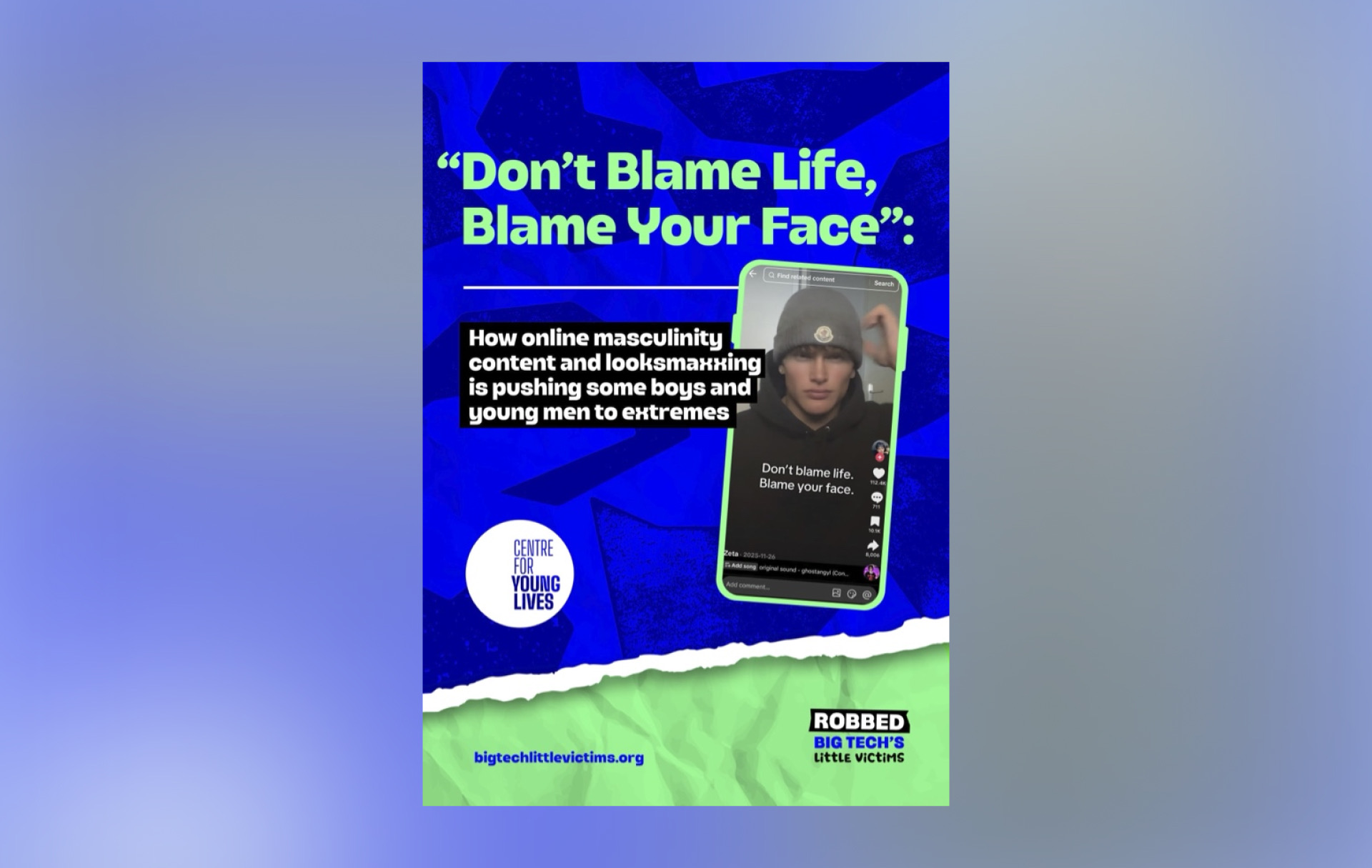
The report, ‘Don’t blame life, blame your face’, is the first national study into looksmaxxing. It is funded by the National Education Union and is published as part of the ‘Big Tech’s Little Victims’ campaign and comes shortly after the Government announced raising the minimum age on social media use to 16. The report provides a comprehensive look at how looksmaxxing is impacting on the lives of many boys and young men in England by bringing together focus groups of 13–to-18-year-old boys, expert interviews, and by undercover research on TikTok, Instagram, YouTube, and Reddit using an alias of a 14-year-old boy.
The report reveals how the growth of ‘bro science’ and the negative influences of the most aggressive and misogynistic aspects of the ‘Manosphere’ - a web of online communities and content promoting regressive ideas about masculinity and women - are feeding millions of boys and young men content from an early age that is deeply harmful to their view of themselves, of girls and young women, and of the wider world.
It shows how looksmaxxing can be a gateway into a wider network of this online masculinity content that centres dominance, hierarchy, and contempt for women. The boys and young men who talked to the Centre for Young Lives for the report talked about “Chads,” “foids,” and “sexual market value”, terms which used to be confined to incel forums but are now becoming normalised.
Harms associated with looksmaxxing are also racialised with the ‘criteria’ to be attractive within the looksmaxxing community often predicated on a “Eurocentric” conception of masculinity, which disregards diverse cultural and ethnic expressions of attractiveness. Major looksmaxxing influencers have used racist slurs and promoted white supremacy, while degrading non white men.
Fuelled by social media algorithms that reward extreme material, this kind of content now reaches millions of young men, with 61% following at least one masculinity influencer. Boys say they see looksmaxxing content without searching for it, that it sits beside gym and ‘self-improvement’ content on their social media feeds, and that it blurs into the language they hear at school. It is feeding a growing and unhealthy obsession with ratings, rankings, and a warped vision of masculinity.
The report warns that notable looksmaxxing influencers, such as Clavicular, are attracting huge audiences. His 47 most recent TikToks have all received over one million views, with one video peaking at 12 million views and over 500,000 likes. K. Shami has 1.9 million TikTok followers and 135 million likes across his posts. Reddit communities are also active, with r/LooksmaxingAdvice drawing 67,500 weekly visitors, while the major looksmaxxing forum, looksmax.org, where users share selfies, ratings, and advice, has grown from 60,000 to 144,000 members in the past year.
The report also warns that the growing appeal of the ‘Manosphere’ ecosystem, and the looksmaxxing phenomenon has gone largely unnoticed in Parliament and is unregulated by the Online Safety Act, even as boys describe seeing it daily on their social media feeds. It backs the Government’s recent announcement that it will raise the minimum age for social media use to 16.
Key findings
- Looksmaxxing content is moving rapidly from the fringes of online forums into the mainstream and is now appearing widely across social media platforms like TikTok, Instagram, YouTube and Reddit. Looksmaxxing content is widespread, with almost all the boys in the Centre for Young Lives focus groups having heard or engaged with looksmaxxing ideas. Its terminology has now entered school culture.
- Looksmaxxing content is reshaping how many boys see themselves, by promoting the belief that a boy’s value, success, and relationships are determined primarily by physical appearance. Content can escalate from skincare and gym routines to extreme methods of appearance-changing such as bone-smashing, “starvemaxxing”, steroid cycles, and unregulated peptide injections.
- Boys are encountering online looksmaxxing content without even searching for it. Harmful content is regularly embedded itself into every day social media feeds alongside fitness and lifestyle advice. Boys described falling into algorithm-driven “rabbit holes” that normalise increasingly extreme behaviour.
- Social media algorithms are accelerating harm and exploitation and actively push increasingly extreme content to maximise engagement. Influencers are profiting from insecurity, selling courses, products, and pseudoscientific “solutions” promising “ascension”.
- Looksmaxxing can be a gateway to misogyny and extremism. Content frequently carries misogynistic ideas, framing women as objects and reinforcing gender hierarchy. Boys talk about the widespread use of dehumanising language about women and exposure to racist and far-right narratives, with looksmaxxing often acting as a gateway into broader “manosphere” content and online radicalisation.
- Many boys said they feel addicted to social media and lack trusted adults or spaces to discuss masculinity, body image, and mental health. A vacuum of guidance is pushing some to seek answers online from harmful sources.
Key recommendations
The report calls for a speedy, comprehensive response from Government, regulators, schools, and industry.
- The report backs introducing a minimum age of 16 for social media platforms, requiring platforms to remove addictive design features such as endless scroll and algorithmic amplification, and shifting the burden onto tech companies to prove their platforms are safe.
- It calls on Ofcom to formally recognise looksmaxxing and harmful masculinity content as an online harm and classifying all body stigma content as Primary Priority Content.
- The report urges more support for schools to deliver the new RSHE curriculum. Schools often lack the time, resources, and expertise to tackle rapidly evolving online trends relating to masculinity and body image. They should be supported to utilise expert external providers to deliver high-quality lessons on masculinity, body image, and online influences. This should go alongside support for schools to deliver a more holistic, whole-school approach to teaching healthy masculinity and positive body image.
- It calls for improved research into boys’ body image, steroid use, and eating disorders alongside expanded support for services for affected young people.
- It proposes the introduction of stronger oversight of the peptide and supplement market and a crackdown on unregulated products marketed to young people.
- The report calls for the provision of more information and support for parents, youth workers, and gym staff to spot warning signs and develop partnerships between youth services and gyms to promote safer habits.
- It calls for investment in youth spaces and offline activities to reduce reliance on social media, funded by levies on tech platforms.
Haroon Chowdry, CEO of the Centre for Young Lives, said:
“Looksmaxxing’ content is now being pumped onto the phone screens of boys and young men by the relentless, addictive algorithms that have become part and parcel of growing up.
“This content may not be illegal or pornographic, but it can pollute boys’ senses of themselves and the world around them, as well as their relationships. Underneath the veneer of self-improvement, it sends a deeply harmful message: that how you look determines your identity, worth and place in society. We have seen how it can also be gateway into a culture that prizes intolerance, bigotry, and misogyny.
“This research is yet another example of toxic social media content and algorithms damaging young people’s minds. We have allowed a system that causes – and then profits from – insecurity to go unchecked for far too long. The Government is right to raise the minimum age for social media to 16 but will need to go further to reset young people’s relationship with social media.”
Daniel Kebede, general secretary of the National Education Union, said:
“A generation of boys is being dragged into a toxic online world that tells them they are not good-looking enough and that is why they do not feel successful enough. Ultimately this dangerous phenomenon has a common thread to other areas of the manosphere - widespread misogyny.
“All of this is being pushed to teenagers by algorithms designed to maximise profit. Educators see the damage this is causing every day: misogyny, rising anxiety, low self-esteem. And they are being left on their own to deal with it.
“We are failing our young people by not acting to keep them safe online. The Government recently took decisive action to ban social media for under-16s. Now we must take action to tackle this dangerous content.”
ENDS
Centre for Young Lives CEO Haroon Chowdry and NEU General Secretary Daniel Kebede are available for pre-recorded and live interviews. For further information and interview requests for Haroon Chowdry contact Jo Green, Director of Comms, Centre for Young Lives: jo.green@centreforyounglives.org or mobile/WhatsApp 07715105415. For interview requests for Daniel Kebede contact press@neu.org.uk / 07879 480 061.
NOTES TO EDITORS:
- The full report, “Don’t Blame Life, Blame Your Face”, is published by the Centre for Young Lives, an independent think tank focused on improving outcomes for children and young people. The research was funded by the National Education Union and is part of the Big Tech’s Little Victims campaign.
- The Centre for Young Lives held five focus groups with boys aged between 13 and 18 in late 2025. Older participants in our focus groups, 16-18-year-olds, were some of the most critical about the harmful impact social media can have, explaining how they felt addicted to scrolling, disarming them of agency over their lives. Quotes from the focus groups are available throughout the report.
Meet the Authors
Meet the Author