
Blog

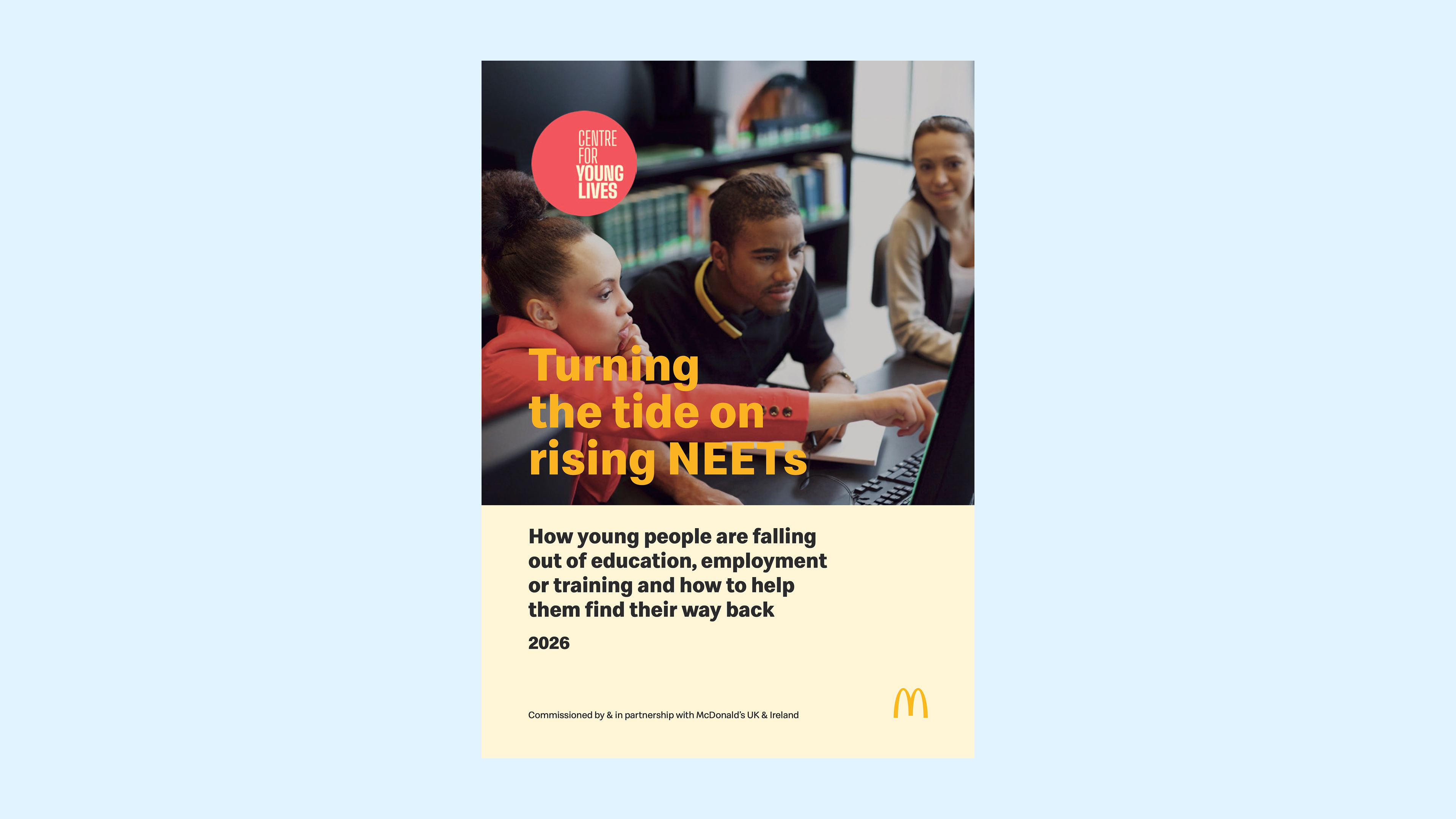
Turning the Tide on Rising Young NEETs: New report from Centre for Young Lives sets out a new vision for a system-wide approach to shifting the dial on young people not in education, employment or training

April 23, 2026
April 22, 2026
| by
Anna Heuschkel

For too many young people today, leaving school no longer feels like the beginning of the rest of their lives. Instead, too many are facing uncertainty about their future at a point in their life where support falls away and pathways forward are not always clear.

Almost one million young people are falling into unemployment or inactivity with little support to help them find their way back. Being Not in Education, Employment or Training (NEET) at a young age is not a temporary setback from which all will easily recover - it can cast a long shadow across a lifetime. Behind this headline figure is not a story of individual failure, but one of systems that are struggling to keep pace with the realities many young people face.

There is cause for hope. The Government has shown a welcome focus and ambition to reverse the trend of rising youth unemployment and inactivity. The Youth Guarantee, reforms to apprenticeships and jobcentre support, and new financial incentives for employers are all key parts of the puzzle to unlocking more opportunities for young people. And yet there is still much further to go.

The Centre for Young Lives is pleased to have partnered with McDonald’s - one of the largest employers of young people in the UK, and who today have launched the largest ever work experience for young people – to publish this report. 

Our report puts young people’s voices at the centre of finding solutions, building on Government efforts so far and going even further by reimagining a system-wide model that prioritises early intervention and prevention and reverses the trend of rising NEETs for good. 

[.download]Download the report[.download]

Who are the NEETs?

The term “NEET” often suggests a single, uniform group. However, the picture is far more complex.

The nature of the NEET cohort has shifted in recent years. Today’s NEET population is increasingly shaped not by unemployment, but by economic inactivity. This has been driven in large part by rising numbers of young people out of work due to long-term sickness and disability, now accounting for just over a quarter of the overall NEET population. 

This shift took place long before the pandemic and requires an approach that recognises the new challenges young people face. These challenges are in large part reflected by the rising rate of poor mental health – now impacting one in five children and young people – and the number of young people with SEND. That is why it’s particularly welcome to have the Prevalence Review into mental health, ADHD and autism running alongside the Milburn Review. 

‘Hidden NEETs” - young people who are not claiming benefits and are therefore largely invisible to the system – make up almost half of the overall NEET cohort. As we set out in this report, these young people present a specific challenge for government – how do you incentivise them to re-engage with services and access opportunities that might be available to them? 

What barriers do they face?

Young people we spoke with consistently expressed a desire for stability, independence, and purpose – recognising the value of jobs or training beyond just collecting a paycheque. The issue for them is not willingness to participate, it is the complex and often overlapping barriers that prevent them from doing so.

The labour market has become increasingly difficult to enter, and policy decisions have created additional barriers for employers in hiring young people. Entry-level roles and jobs in typically youth-dominated industries like retail and hospitality, once a key stepping stone and a young person’s first taste of the working world, are declining, with young people being squeezed out in favour of more experienced candidates. As a result, young people’s first experience of work is usually coming later, not equipping some with the key skills they need to progress throughout their career.

At the same time, statutory employment support is not currently designed to support young people into meaningful opportunities. Support can feel short-term, impersonal, and focused on immediate outcomes rather than long-term progression which can lead to cycles of only short-term employment. For those with more complex needs, this approach can be particularly ineffective as it lacks wider, holistic support that recognises their additional needs. 

The education system also has a key role to play in setting young people up for their future. Too many young people are leaving school without the confidence, skills, or guidance needed to navigate the transition into work. Careers education is inconsistent and comes too late in their schooling, access to work experience has declined, and key life skills - from communication to financial literacy - are often underdeveloped undermines work readiness and creates a skills gap for employers.

A lack of investment and focus on early identification and intervention means that for young people with additional needs like SEND or heightened risk of becoming NEET, early warning signs are frequently missed. The current system is one where support is not needs-led, and is often coming far too late, leaving challenges and problems to escalate unaddressed

Finally, overlaying these challenges is a fragmented system of support for young people, particularly around transition. Cuts to and strains on local authority budgets in recent years have undermined better coordination that deliversthe necessary support to young people. As a result, many fall through gaps in services and out of the system.

What does the report recommend?

While we strongly welcome Government’s ambition in reversing this trend and the £2.5bn committed over the next three years, our research makes clear that piecemeal solutions will not be enough to truly shift the dial. 

Our report builds on the current momentum, and cross-sector buy-in, and sets out a vision for a system-wide response to reverse the trend of rising NEETs through prevention, early intervention, and joined-up support.

The model we set out builds on the early successes of the Youth Guarantee trailblazers. These bring together the full range of local partners to develop a locally-led, place-based model of joined-up services that ensures support is in place as early as the age of 5 and continues to adulthood, with each partner stepping more fully into their role in setting young people up for life.

Our report recommends:

Government should establish a cross-departmental strategy to integrate support for young people at risk of being NEET. The strategy should all relevant departments to align Government initiatives (Young Futures Hubs, DWP Youth Hubs, Best Start Family Hubs and Neighbourhood Health Centres) to provide a comprehensive, joined-up approach to identifying and supporting young people at risk of becoming NEET. 

To test this model, we recommend Government fund pilots in three local areas to develop a system-wide, place-based model to prevent young people becoming NEET. Targeted in areas of high number of young NEETs, the pilots should adopt a test and learn approach, and bring together the full range of partners – education (primary and secondary), local authorities, health, voluntary sector, local business and employers – to establish a model of support for young people that starts long before 16 and continues throughout their journey.

The report makes several other recommendations to national and local government, schools, Trusts and colleges and employers to ensure each are playing their role in being part of the solution to reverse the trend of young NEETs. This includes:
  •  A key focus on preventing NEETs through implementation of the reforms of the Schools White Paper – including in expanding pathways to support and opportunities for young people at risk of becoming NEET
  • Strengthening and expanding tracking and accountability of young people at risk, or who are already NEET by bringing partners together to identify young people from age 5, and extending long-term destination tracking to 25 to prevent cliff edges of support.
  • Support for local authorities to becoming system leaders in convening a place-based response.
  • Support for schools and colleges to embed a whole-school approach to education that begins in year 7 – backed by sustainable, ringfenced funding
  • Strengthening engagement and partnership with employers to promote best practice in recruiting and employing young people through co-production of National Standards and a Quality Kitemark for youth-friendly employers. 
  • Efforts to break the link between poor mental health and inactivity by strengthening targeted support and pathways for young people with poor mental health and strengthening integration of mental health support in services like DWP Youth Hubs and Young Futures Hubs

The scale of the challenge is significant, but so too is the opportunity. There is growing recognition across government, employers, and the wider sector that change is needed. The question now is whether this recognition can be translated into sustained, coordinated action.

Young people are clear about what they want: the chance to build a future, to contribute, and to thrive. Turning the tide on rising NEETs is not simply about reducing a statistic. It is about unlocking potential of our young people.

You can read our report and recommendations here.

[.download]Download the report[.download]

Meet the Authors

No items found.

Read more like this

Blog

Turning the Tide on Rising Young NEETs: New report from Centre for Young Lives sets out a new vision for a system-wide approach to shifting the dial on young people not in education, employment or training

April 23, 2026
April 22, 2026
| by
Anna Heuschkel

For too many young people today, leaving school no longer feels like the beginning of the rest of their lives. Instead, too many are facing uncertainty about their future at a point in their life where support falls away and pathways forward are not always clear.

Almost one million young people are falling into unemployment or inactivity with little support to help them find their way back. Being Not in Education, Employment or Training (NEET) at a young age is not a temporary setback from which all will easily recover - it can cast a long shadow across a lifetime. Behind this headline figure is not a story of individual failure, but one of systems that are struggling to keep pace with the realities many young people face.

There is cause for hope. The Government has shown a welcome focus and ambition to reverse the trend of rising youth unemployment and inactivity. The Youth Guarantee, reforms to apprenticeships and jobcentre support, and new financial incentives for employers are all key parts of the puzzle to unlocking more opportunities for young people. And yet there is still much further to go.

The Centre for Young Lives is pleased to have partnered with McDonald’s - one of the largest employers of young people in the UK, and who today have launched the largest ever work experience for young people – to publish this report. 

Our report puts young people’s voices at the centre of finding solutions, building on Government efforts so far and going even further by reimagining a system-wide model that prioritises early intervention and prevention and reverses the trend of rising NEETs for good. 

[.download]Download the report[.download]

Who are the NEETs?

The term “NEET” often suggests a single, uniform group. However, the picture is far more complex.

The nature of the NEET cohort has shifted in recent years. Today’s NEET population is increasingly shaped not by unemployment, but by economic inactivity. This has been driven in large part by rising numbers of young people out of work due to long-term sickness and disability, now accounting for just over a quarter of the overall NEET population. 

This shift took place long before the pandemic and requires an approach that recognises the new challenges young people face. These challenges are in large part reflected by the rising rate of poor mental health – now impacting one in five children and young people – and the number of young people with SEND. That is why it’s particularly welcome to have the Prevalence Review into mental health, ADHD and autism running alongside the Milburn Review. 

‘Hidden NEETs” - young people who are not claiming benefits and are therefore largely invisible to the system – make up almost half of the overall NEET cohort. As we set out in this report, these young people present a specific challenge for government – how do you incentivise them to re-engage with services and access opportunities that might be available to them? 

What barriers do they face?

Young people we spoke with consistently expressed a desire for stability, independence, and purpose – recognising the value of jobs or training beyond just collecting a paycheque. The issue for them is not willingness to participate, it is the complex and often overlapping barriers that prevent them from doing so.

The labour market has become increasingly difficult to enter, and policy decisions have created additional barriers for employers in hiring young people. Entry-level roles and jobs in typically youth-dominated industries like retail and hospitality, once a key stepping stone and a young person’s first taste of the working world, are declining, with young people being squeezed out in favour of more experienced candidates. As a result, young people’s first experience of work is usually coming later, not equipping some with the key skills they need to progress throughout their career.

At the same time, statutory employment support is not currently designed to support young people into meaningful opportunities. Support can feel short-term, impersonal, and focused on immediate outcomes rather than long-term progression which can lead to cycles of only short-term employment. For those with more complex needs, this approach can be particularly ineffective as it lacks wider, holistic support that recognises their additional needs. 

The education system also has a key role to play in setting young people up for their future. Too many young people are leaving school without the confidence, skills, or guidance needed to navigate the transition into work. Careers education is inconsistent and comes too late in their schooling, access to work experience has declined, and key life skills - from communication to financial literacy - are often underdeveloped undermines work readiness and creates a skills gap for employers.

A lack of investment and focus on early identification and intervention means that for young people with additional needs like SEND or heightened risk of becoming NEET, early warning signs are frequently missed. The current system is one where support is not needs-led, and is often coming far too late, leaving challenges and problems to escalate unaddressed

Finally, overlaying these challenges is a fragmented system of support for young people, particularly around transition. Cuts to and strains on local authority budgets in recent years have undermined better coordination that deliversthe necessary support to young people. As a result, many fall through gaps in services and out of the system.

What does the report recommend?

While we strongly welcome Government’s ambition in reversing this trend and the £2.5bn committed over the next three years, our research makes clear that piecemeal solutions will not be enough to truly shift the dial. 

Our report builds on the current momentum, and cross-sector buy-in, and sets out a vision for a system-wide response to reverse the trend of rising NEETs through prevention, early intervention, and joined-up support.

The model we set out builds on the early successes of the Youth Guarantee trailblazers. These bring together the full range of local partners to develop a locally-led, place-based model of joined-up services that ensures support is in place as early as the age of 5 and continues to adulthood, with each partner stepping more fully into their role in setting young people up for life.

Our report recommends:

Government should establish a cross-departmental strategy to integrate support for young people at risk of being NEET. The strategy should all relevant departments to align Government initiatives (Young Futures Hubs, DWP Youth Hubs, Best Start Family Hubs and Neighbourhood Health Centres) to provide a comprehensive, joined-up approach to identifying and supporting young people at risk of becoming NEET. 

To test this model, we recommend Government fund pilots in three local areas to develop a system-wide, place-based model to prevent young people becoming NEET. Targeted in areas of high number of young NEETs, the pilots should adopt a test and learn approach, and bring together the full range of partners – education (primary and secondary), local authorities, health, voluntary sector, local business and employers – to establish a model of support for young people that starts long before 16 and continues throughout their journey.

The report makes several other recommendations to national and local government, schools, Trusts and colleges and employers to ensure each are playing their role in being part of the solution to reverse the trend of young NEETs. This includes:
  •  A key focus on preventing NEETs through implementation of the reforms of the Schools White Paper – including in expanding pathways to support and opportunities for young people at risk of becoming NEET
  • Strengthening and expanding tracking and accountability of young people at risk, or who are already NEET by bringing partners together to identify young people from age 5, and extending long-term destination tracking to 25 to prevent cliff edges of support.
  • Support for local authorities to becoming system leaders in convening a place-based response.
  • Support for schools and colleges to embed a whole-school approach to education that begins in year 7 – backed by sustainable, ringfenced funding
  • Strengthening engagement and partnership with employers to promote best practice in recruiting and employing young people through co-production of National Standards and a Quality Kitemark for youth-friendly employers. 
  • Efforts to break the link between poor mental health and inactivity by strengthening targeted support and pathways for young people with poor mental health and strengthening integration of mental health support in services like DWP Youth Hubs and Young Futures Hubs

The scale of the challenge is significant, but so too is the opportunity. There is growing recognition across government, employers, and the wider sector that change is needed. The question now is whether this recognition can be translated into sustained, coordinated action.

Young people are clear about what they want: the chance to build a future, to contribute, and to thrive. Turning the tide on rising NEETs is not simply about reducing a statistic. It is about unlocking potential of our young people.

You can read our report and recommendations here.
[.download]Download the report[.download]

Meet the Authors

No items found.

Meet the Author

Anna Heuschkel
Policy Researcher at the Centre for Young Lives & Early Years Lead

Read more like this