
Blog

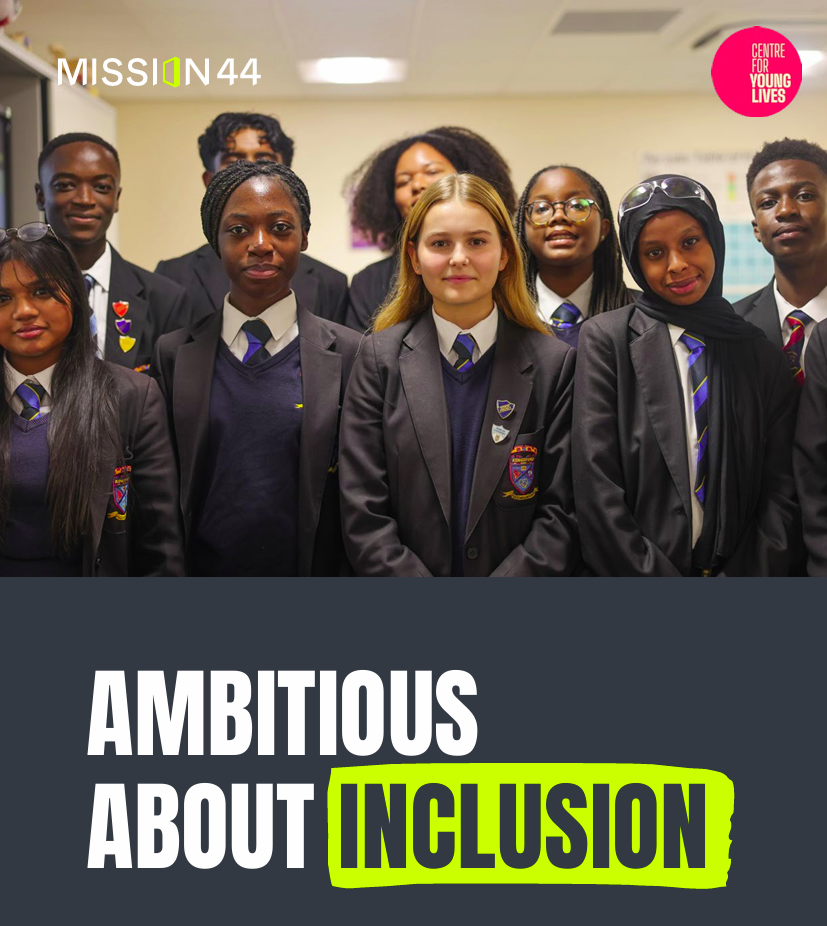
Mission 44 and the Centre for Young Lives publish Ambitious About Inclusion Report

June 16, 2026
June 16, 2026
| by
Jonny Uttley

In partnership with Mission 44, the Centre for Young Lives are today publishing our new report, ‘Ambitious About Inclusion: A Guide to Implementing the Schools White Paper.’

The report draws together insights from a national series of Ambitious About Inclusion events held across eight regions in England, bringing together nearly 500 young people, educators, local authorities, health partners and community organisations to explore how the ambitions set out in the Schools White Paper can be translated into meaningful and sustainable practice.

It highlights what is working locally, where barriers remain, and the practical steps needed to build a more inclusive education system. Participants emphasised the importance of early support, stronger partnerships between services, inclusive school cultures and ensuring that young people's voices are at the heart of reform. 

[.download]Download the report[.download]

Jonny Uttley, former CEO of The Education Alliance, reflects on what he learned from listening to young people, educators and communities across England – and why inclusion is the foundation of excellence.

Over the last 18 months, I have had the privilege of working with Mission 44 and The Centre for Young Lives on our Ambitious About Inclusion project. Together, we travelled across England, bringing together school leaders, teachers, local authorities, health partners, community organisations and, most importantly, young people themselves.

In every region, we found ambitious schools and communities already building more inclusive systems. We met leaders determined to ensure that every child belongs. We heard from young people with a clear vision of what a better education system could look like. And we saw practical solutions already working in places often written off as too challenging or too complex.

The publication of the Schools White Paper creates an opportunity. For the first time in a generation, inclusion is being framed not as separate from standards, but as fundamental to achieving them. That reflects one of the strongest messages from our events and is explored throughout the Ambitious About Inclusion report inclusion and achievement are not competing priorities. Inclusion is how we secure better outcomes for more children.

Yet there remains a significant gap between ambition and reality.

Across the country, we heard the same frustrations. Too often support arrives only after a child has reached crisis point. Schools face long waits for specialist services. Families navigate fragmented systems that rarely join up. Children can find themselves passed between agencies rather than supported by them.

The challenge is not a lack of commitment. The challenge is a system that remains too reactive, too fragmented and too inconsistent. If we are serious about building a system where every child can achieve and thrive, four shifts need to happen.

First, we must become much better at intervening early.

Everyone who works with young people knows that prevention is better than cure. Yet our systems are still largely designed around escalation. By the time support arrives, attendance has deteriorated, behaviour has become a concern, and relationships have broken down.

The schools making the greatest progress are often those that have flipped this model. They invest heavily in relationships. They know their families well. They identify emerging needs early and act quickly. They understand that attendance, behaviour and wellbeing are not separate issues but indicators of the same underlying story.

Second, we need genuinely connected local systems. One consistent theme from the roadshows was the power of partnership. In places like Leeds, Manchester and London, we saw schools, trusts, local authorities, health services and community organisations working together around shared goals.

Schools remain the most important civic institutions in many communities, but they cannot carry the weight of every challenge facing children and families. The most successful systems are those where responsibility is shared, organisations collaborate rather than compete, and the question is not “Whose child is this?” but “How do we collectively help this child thrive?”.

Third, we must rethink accountability. For nearly four decades, English education has operated within a framework largely shaped by the 1988 Education Reform Act. Competition became the driving force. Schools competed for pupils, results, reputation and inspection outcomes. That approach raised standards in some areas but also created unintended consequences.

Too often, accountability systems reward short-term performance and ignore belonging, wellbeing and inclusion. When leaders feel forced to choose between doing what is right for a child and what satisfies accountability measures, something has gone wrong.

The answer is not less accountability. It is more intelligent accountability. We should measure how effectively schools and trusts create cultures of belonging. We should recognise those who keep vulnerable children engaged. We should reward collaboration and collective responsibility, not simply institutional performance.

Finally, we must listen much more carefully to young people. One of the most powerful aspects of the events was the contribution of young people themselves. Again and again, they told us the same thing: they want to be partners in change, not subjects of it.

Their insights brought a different perspective to the adults in the room. They spoke about belonging, representation, trust and relationships. They challenged assumptions and highlighted barriers adults sometimes don’t see. Most importantly, they reminded us that inclusion has to be experienced, not just designed. Policies matter. Structures matter. Funding matters. But children experience inclusion through everyday interactions, relationships and opportunities.

As the White Paper moves from aspiration to implementation, there is a huge opportunity ahead. We do not need to invent inclusion from scratch. Across England, schools, trusts and communities are already demonstrating what works. The task now is to create the conditions that allow those approaches to flourish at scale.

For school leaders and policymakers shaping the future of education, the Ambitious About Inclusion report is essential reading. The ambition exists. The expertise exists. The models exist. The challenge now is whether we are willing to build a system that values them.

Because inclusion is not the alternative to excellence – it is the only route to it.

– Jonny Uttley, Education Leadership Consultant, Recent Trust CEO, Visiting Fellow Centre for Young Lives

[.download]Download the report[.download]

Meet the Authors

Jonny Uttley
Visiting Fellow

Read more like this

Blog

Mission 44 and the Centre for Young Lives publish Ambitious About Inclusion Report

June 16, 2026
June 16, 2026
| by
Jonny Uttley

In partnership with Mission 44, the Centre for Young Lives are today publishing our new report, ‘Ambitious About Inclusion: A Guide to Implementing the Schools White Paper.’

The report draws together insights from a national series of Ambitious About Inclusion events held across eight regions in England, bringing together nearly 500 young people, educators, local authorities, health partners and community organisations to explore how the ambitions set out in the Schools White Paper can be translated into meaningful and sustainable practice.

It highlights what is working locally, where barriers remain, and the practical steps needed to build a more inclusive education system. Participants emphasised the importance of early support, stronger partnerships between services, inclusive school cultures and ensuring that young people's voices are at the heart of reform. 

[.download]Download the report[.download]

Jonny Uttley, former CEO of The Education Alliance, reflects on what he learned from listening to young people, educators and communities across England – and why inclusion is the foundation of excellence.

Over the last 18 months, I have had the privilege of working with Mission 44 and The Centre for Young Lives on our Ambitious About Inclusion project. Together, we travelled across England, bringing together school leaders, teachers, local authorities, health partners, community organisations and, most importantly, young people themselves.

In every region, we found ambitious schools and communities already building more inclusive systems. We met leaders determined to ensure that every child belongs. We heard from young people with a clear vision of what a better education system could look like. And we saw practical solutions already working in places often written off as too challenging or too complex.

The publication of the Schools White Paper creates an opportunity. For the first time in a generation, inclusion is being framed not as separate from standards, but as fundamental to achieving them. That reflects one of the strongest messages from our events and is explored throughout the Ambitious About Inclusion report inclusion and achievement are not competing priorities. Inclusion is how we secure better outcomes for more children.

Yet there remains a significant gap between ambition and reality.

Across the country, we heard the same frustrations. Too often support arrives only after a child has reached crisis point. Schools face long waits for specialist services. Families navigate fragmented systems that rarely join up. Children can find themselves passed between agencies rather than supported by them.

The challenge is not a lack of commitment. The challenge is a system that remains too reactive, too fragmented and too inconsistent. If we are serious about building a system where every child can achieve and thrive, four shifts need to happen.

First, we must become much better at intervening early.

Everyone who works with young people knows that prevention is better than cure. Yet our systems are still largely designed around escalation. By the time support arrives, attendance has deteriorated, behaviour has become a concern, and relationships have broken down.

The schools making the greatest progress are often those that have flipped this model. They invest heavily in relationships. They know their families well. They identify emerging needs early and act quickly. They understand that attendance, behaviour and wellbeing are not separate issues but indicators of the same underlying story.

Second, we need genuinely connected local systems. One consistent theme from the roadshows was the power of partnership. In places like Leeds, Manchester and London, we saw schools, trusts, local authorities, health services and community organisations working together around shared goals.

Schools remain the most important civic institutions in many communities, but they cannot carry the weight of every challenge facing children and families. The most successful systems are those where responsibility is shared, organisations collaborate rather than compete, and the question is not “Whose child is this?” but “How do we collectively help this child thrive?”.

Third, we must rethink accountability. For nearly four decades, English education has operated within a framework largely shaped by the 1988 Education Reform Act. Competition became the driving force. Schools competed for pupils, results, reputation and inspection outcomes. That approach raised standards in some areas but also created unintended consequences.

Too often, accountability systems reward short-term performance and ignore belonging, wellbeing and inclusion. When leaders feel forced to choose between doing what is right for a child and what satisfies accountability measures, something has gone wrong.

The answer is not less accountability. It is more intelligent accountability. We should measure how effectively schools and trusts create cultures of belonging. We should recognise those who keep vulnerable children engaged. We should reward collaboration and collective responsibility, not simply institutional performance.

Finally, we must listen much more carefully to young people. One of the most powerful aspects of the events was the contribution of young people themselves. Again and again, they told us the same thing: they want to be partners in change, not subjects of it.

Their insights brought a different perspective to the adults in the room. They spoke about belonging, representation, trust and relationships. They challenged assumptions and highlighted barriers adults sometimes don’t see. Most importantly, they reminded us that inclusion has to be experienced, not just designed. Policies matter. Structures matter. Funding matters. But children experience inclusion through everyday interactions, relationships and opportunities.

As the White Paper moves from aspiration to implementation, there is a huge opportunity ahead. We do not need to invent inclusion from scratch. Across England, schools, trusts and communities are already demonstrating what works. The task now is to create the conditions that allow those approaches to flourish at scale.

For school leaders and policymakers shaping the future of education, the Ambitious About Inclusion report is essential reading. The ambition exists. The expertise exists. The models exist. The challenge now is whether we are willing to build a system that values them.

Because inclusion is not the alternative to excellence – it is the only route to it.

– Jonny Uttley, Education Leadership Consultant, Recent Trust CEO, Visiting Fellow Centre for Young Lives

[.download]Download the report[.download]

Meet the Authors

Jonny Uttley
Visiting Fellow

Meet the Author

Jonny Uttley
Visiting Fellow, Centre for Young Lives and CEO, The Education Alliance

Read more like this