Blog

Effective “early help”: 18 essentials for effective support

October 29, 2026
October 29, 2026
| by
Centre for Young Lives

There is widespread agreement that “early help” matters, yet there is often less clarity about what effective early help looks like in practice. This topic is increasingly central to the national conversation on how we better support parents, children and families to prevent crises. This includes homelessness, ill health, family breakdown and involvement in the criminal justice system. 

The Government’s Giving every child the best start in life strategy and investment in new Family Hubs and the Families First Partnership, demonstrate a renewed emphasis on prevention and joined-up family support.  The Government’s devolution agenda also creates opportunities to put more power into the hands of local areas to improve local early intervention collaboration and partnerships.

Against this backdrop we have published a new report into the current early help evidence base, entitled Early Help and Early Intervention: An Analytical Review. This identifies 18 characteristics that are central to effective support designed to improve the circumstances of a parent, child or family before and up until crisis point. These included interventions delivered by statutory and third sector services.

Our findings

Many organisations are doing brilliant work but do not have the resource to invest in high-quality academic evaluations. Our review therefore considered a broader range of available evidence. Vitally, we paid careful attention to the reliability of each study, including credible sample sizes, intervention descriptions, outcome measures and participant follow-up. 87 per cent of the research reviewed was ranked as having high or medium reliability. The review sifted over 5,000 academic, policy and practitioner sources, and analysed 68 early intervention studies that met certain methodological standards.  

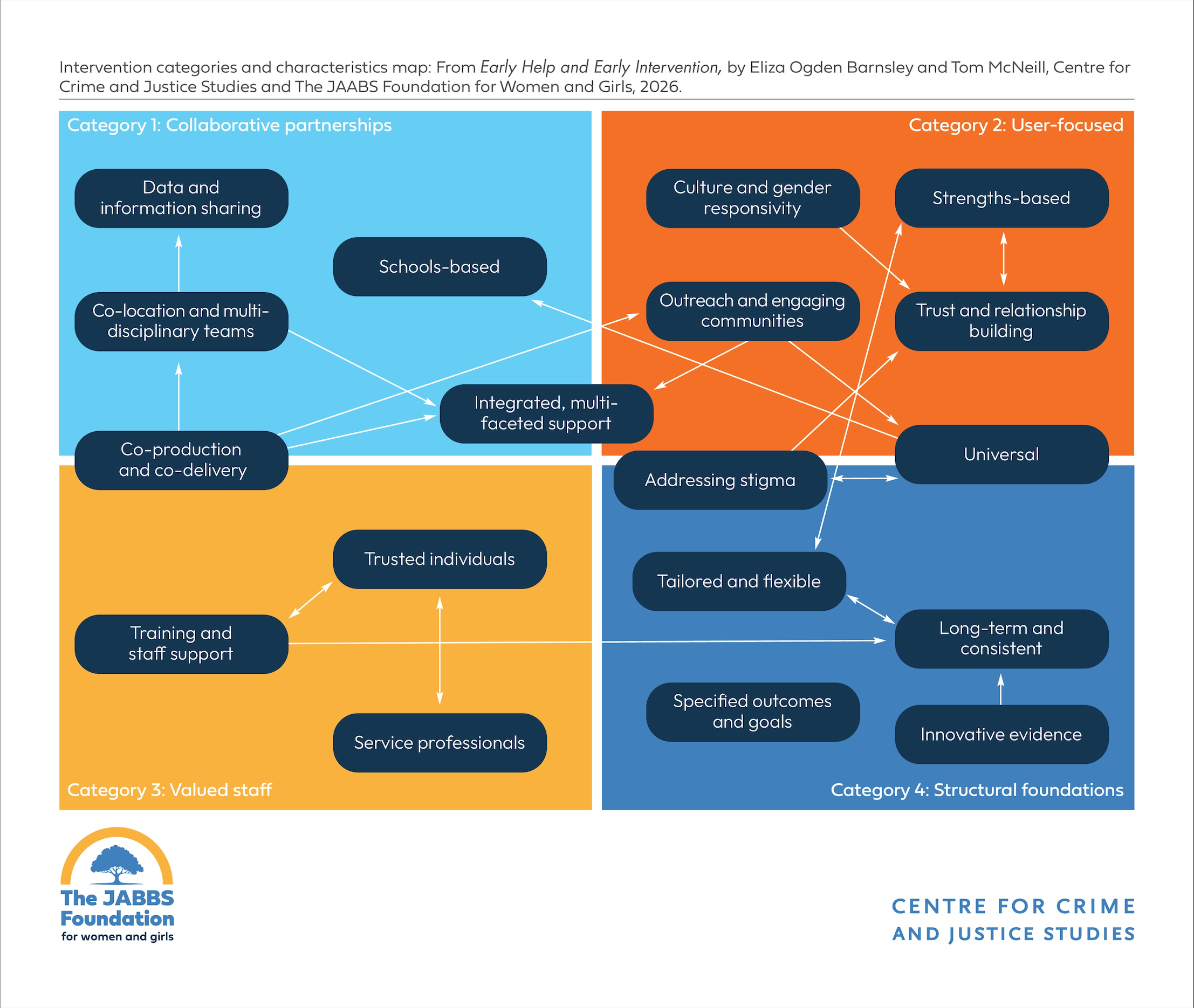
From these 68 studies, we identified 18 interrelated characteristics of effective early help. The list will not surprise anyone. The value in the review is therefore that it demonstrates an emerging evidence base behind the intervention ingredients that are frequently advocated for by practitioners.  The characteristics are as follows:

  1. Integrated and multi-faceted support – support that meets a range of emotional, practical and other needs. 
  2. Co-location and multi-disciplinary teams – co-location of various services and teams in a single place. 
  3. Co-production and co-delivery – multiple partners involved in the design and delivery of the intervention. 
  4. Data and information sharing – sharing information across services to support better care and understanding. 
  5. School-based delivery or referral pathways – recognising schools as key to earlier identification of need. 
  6. Universal access – low thresholds for offer of support. 
  7. Outreach and community engagement – engaging with supported communities to better identify need and build relationships. 
  8. Culture and gender responsivity – dedicated safe spaces or tailored support capable of building trust or sense of safety. 
  9. Strengths-based approaches – identifying people’s strengths and using it as a platform to build confidence and agency. 
  10. Trust and relationship building – sufficient time dedicated to establishing trust. 
  11. Addressing stigma – sensitively addressing and acknowledging issues like shame associated with receiving or needing support.
  12. Trusted individuals – consistent mentors, support workers. 
  13. Tailored and flexible delivery – attempts to accommodate difficult circumstances, adapting support timings, types of delivery methods. 
  14. Long-term and consistent support – support over 6 months and efforts to maintain consistency in delivery. 
  15. Specified outcomes and goals – specific outcomes and goals that are also communicated to service users. 
  16. Innovative approaches to evidence and evaluation – recognising that proof of intervention impact is vital for service sustainability and embedding evidence capture. 
  17. Training and staff support – staff receive regular training and ongoing support. 
  18. Involvement of qualified service professionals – the expertise of qualified professionals is included in the intervention.

Vitally, these intervention characteristics were found to be associated with six types of positive outcomes. These are:

  1. Improved wellbeing such as confidence or belonging (85%);
  2. Better educational outcomes for children (40%);
  3. Improved mental health such as reduced anxiety and depression (19%);
  4. Stronger safeguarding and reduced family risk such as fewer children being class as ‘in need’ (19%);
  5. Stronger parenting and family relationships (47%);
  6. Positive systems change, including better multi-agency collaboration (41%)

The evidence to date strongly suggests that better outcomes arise from a combination of characteristics. Effective early help is rarely a standalone course or referral. It is typically built on relationships, responsive to families’ multiple needs, sustained for longer and connected to wider services. Housing instability, debt, mental ill health, education needs, domestic abuse and addiction often overlap. Effective early help therefore brings support together around the whole family rather than leaving people to navigate disconnected services.
Translating evidence into ambition

The Government’s family support reforms offer a real opportunity to help parents, children and families earlier, backed by the current evidence. 

Devolution and associated funding flexibilities could empower local areas to bring public services and community-based organisations closer together around the needs of their communities. Flexibility should be coupled with shared standards, long-term funding and robust evaluation to understand more about "what works".

To turn these ambitions into action, commissioners and policymakers should embed the review’s evidence-informed characteristics into funding frameworks and tenders.  This way, commissioning can build on emerging evidence rather than reinventing the wheel.

The evidence is imperfect and further mixed-methods research is needed, and we are aware of many ambitious projects across the country. The JABBS Foundation for Women and Girls is investing in one such example - a large-scale research project with University of Birmingham and Birmingham Pathfinder CIC, involving the development of a new Family Wellbeing Assessment (FWA). This will generate real-time data into the effectiveness of Pathfinder’s ‘early help’ family support offer. While the long-term evidence base grows, commissioners and policy makers have enough evidence to act now and strengthen opportunities for joined-up early help for families. 

Meet the Authors

Eliza Ogden Barnsley
Research and Policy Officer, The JABBS Foundation for Women and Girls
Dr Tom McNeil
Chief Executive Officer, The JABBS Foundation for Women and Girls

Meet the Author

Centre for Young Lives

Read more like this

Blog

Effective “early help”: 18 essentials for effective support

October 29, 2026
October 29, 2026
| by
Centre for Young Lives

There is widespread agreement that “early help” matters, yet there is often less clarity about what effective early help looks like in practice. This topic is increasingly central to the national conversation on how we better support parents, children and families to prevent crises. This includes homelessness, ill health, family breakdown and involvement in the criminal justice system. 

The Government’s Giving every child the best start in life strategy and investment in new Family Hubs and the Families First Partnership, demonstrate a renewed emphasis on prevention and joined-up family support.  The Government’s devolution agenda also creates opportunities to put more power into the hands of local areas to improve local early intervention collaboration and partnerships.

Against this backdrop we have published a new report into the current early help evidence base, entitled Early Help and Early Intervention: An Analytical Review. This identifies 18 characteristics that are central to effective support designed to improve the circumstances of a parent, child or family before and up until crisis point. These included interventions delivered by statutory and third sector services.

Our findings

Many organisations are doing brilliant work but do not have the resource to invest in high-quality academic evaluations. Our review therefore considered a broader range of available evidence. Vitally, we paid careful attention to the reliability of each study, including credible sample sizes, intervention descriptions, outcome measures and participant follow-up. 87 per cent of the research reviewed was ranked as having high or medium reliability. The review sifted over 5,000 academic, policy and practitioner sources, and analysed 68 early intervention studies that met certain methodological standards.  

From these 68 studies, we identified 18 interrelated characteristics of effective early help. The list will not surprise anyone. The value in the review is therefore that it demonstrates an emerging evidence base behind the intervention ingredients that are frequently advocated for by practitioners.  The characteristics are as follows:

  1. Integrated and multi-faceted support – support that meets a range of emotional, practical and other needs. 
  2. Co-location and multi-disciplinary teams – co-location of various services and teams in a single place. 
  3. Co-production and co-delivery – multiple partners involved in the design and delivery of the intervention. 
  4. Data and information sharing – sharing information across services to support better care and understanding. 
  5. School-based delivery or referral pathways – recognising schools as key to earlier identification of need. 
  6. Universal access – low thresholds for offer of support. 
  7. Outreach and community engagement – engaging with supported communities to better identify need and build relationships. 
  8. Culture and gender responsivity – dedicated safe spaces or tailored support capable of building trust or sense of safety. 
  9. Strengths-based approaches – identifying people’s strengths and using it as a platform to build confidence and agency. 
  10. Trust and relationship building – sufficient time dedicated to establishing trust. 
  11. Addressing stigma – sensitively addressing and acknowledging issues like shame associated with receiving or needing support.
  12. Trusted individuals – consistent mentors, support workers. 
  13. Tailored and flexible delivery – attempts to accommodate difficult circumstances, adapting support timings, types of delivery methods. 
  14. Long-term and consistent support – support over 6 months and efforts to maintain consistency in delivery. 
  15. Specified outcomes and goals – specific outcomes and goals that are also communicated to service users. 
  16. Innovative approaches to evidence and evaluation – recognising that proof of intervention impact is vital for service sustainability and embedding evidence capture. 
  17. Training and staff support – staff receive regular training and ongoing support. 
  18. Involvement of qualified service professionals – the expertise of qualified professionals is included in the intervention.

Vitally, these intervention characteristics were found to be associated with six types of positive outcomes. These are:

  1. Improved wellbeing such as confidence or belonging (85%);
  2. Better educational outcomes for children (40%);
  3. Improved mental health such as reduced anxiety and depression (19%);
  4. Stronger safeguarding and reduced family risk such as fewer children being class as ‘in need’ (19%);
  5. Stronger parenting and family relationships (47%);
  6. Positive systems change, including better multi-agency collaboration (41%)

The evidence to date strongly suggests that better outcomes arise from a combination of characteristics. Effective early help is rarely a standalone course or referral. It is typically built on relationships, responsive to families’ multiple needs, sustained for longer and connected to wider services. Housing instability, debt, mental ill health, education needs, domestic abuse and addiction often overlap. Effective early help therefore brings support together around the whole family rather than leaving people to navigate disconnected services.

Translating evidence into ambition

The Government’s family support reforms offer a real opportunity to help parents, children and families earlier, backed by the current evidence. 

Devolution and associated funding flexibilities could empower local areas to bring public services and community-based organisations closer together around the needs of their communities. Flexibility should be coupled with shared standards, long-term funding and robust evaluation to understand more about "what works".

To turn these ambitions into action, commissioners and policymakers should embed the review’s evidence-informed characteristics into funding frameworks and tenders.  This way, commissioning can build on emerging evidence rather than reinventing the wheel.

The evidence is imperfect and further mixed-methods research is needed, and we are aware of many ambitious projects across the country. The JABBS Foundation for Women and Girls is investing in one such example - a large-scale research project with University of Birmingham and Birmingham Pathfinder CIC, involving the development of a new Family Wellbeing Assessment (FWA). This will generate real-time data into the effectiveness of Pathfinder’s ‘early help’ family support offer. While the long-term evidence base grows, commissioners and policy makers have enough evidence to act now and strengthen opportunities for joined-up early help for families. 

Meet the Authors

Eliza Ogden Barnsley
Research and Policy Officer, The JABBS Foundation for Women and Girls
Dr Tom McNeil
Chief Executive Officer, The JABBS Foundation for Women and Girls

Meet the Author

Centre for Young Lives

Read more like this